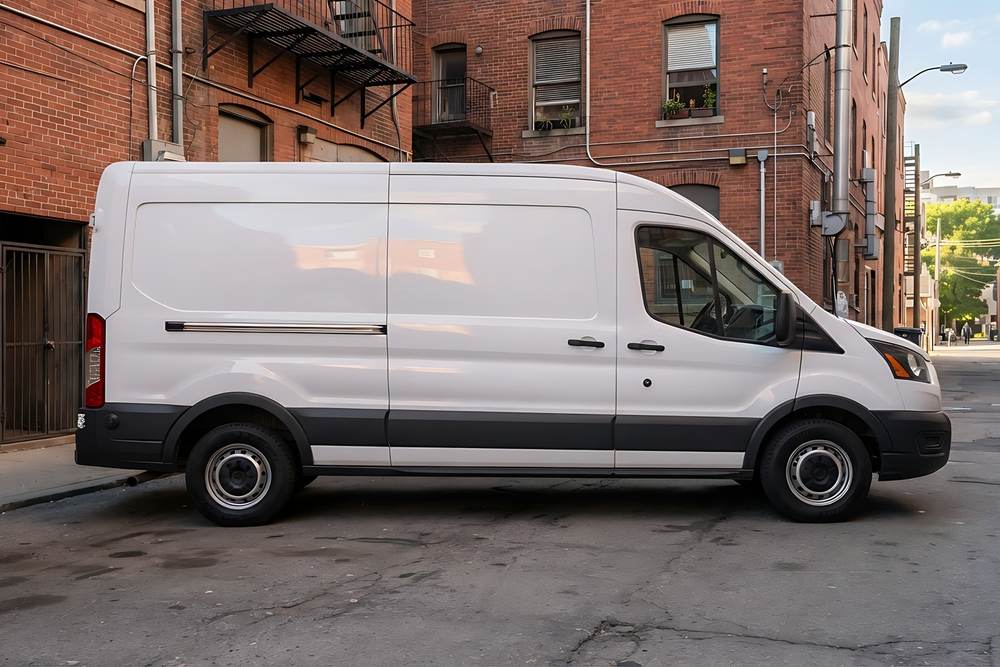
Quick Summary
A well-maintained Ford Transit commonly reaches somewhere in the 200,000 to 250,000-mile range, and some vans with careful owners and highway-heavy routes go further, although no mileage figure is guaranteed. How the van was loaded, driven and serviced matters more than which engine sits under the hood. Following the oil-life monitor, servicing the transmission and cooling system, and staying under the payload rating are the habits that add the most miles. Our inventory changes often, so call (520) 750-0505 or check online for current work vans and trucks, along with financing and warranty options.
Say a landscaper rolls in with a 2016 Transit showing 180,000 miles and wants to know if he should sell it or keep running it, which is really just asking how many miles can a Ford Transit last, only from somebody who’s already got grass clippings in the back.
If his oil changes are all written down in a notebook in the glovebox and it still shifts fine, we’d probably tell him to keep it, and that’s kind of how it goes with these vans, the paperwork and the way it was worked tell you more than the odometer does.
How Many Miles Can a Ford Transit Last in Real-World Use
Most Transits that got their oil changed on time and weren’t overloaded all the time seem to make it to somewhere around 200,000 to 250,000 miles before you’re looking at big engine or transmission work, and some owners get to 300,000, but those are mostly highway vans with a careful owner, so don’t count on it.
City work is rougher on them than you’d think, it’s all stops and starts and idling at the loading dock with the A/C going in July, and none of that shows up on the odometer, so you can have two vans at 120,000 and one’s tired and the other one’s barely broken in.
Ford Transit Engines and How They Hold Up
Ford started selling the full-size Transit here for the 2015 model year, and it’s had four gas and diesel engines so far, so it helps to know which one you’re looking at.
3.7-Liter V6 (2015 to 2019)
This was the base engine in the early vans, no turbos, pretty simple, and honestly that’s why a lot of fleet guys like it, there’s just less on it to go wrong when you’re running it hard for years.
3.5-Liter EcoBoost V6 (2015 and Newer)
The twin-turbo EcoBoost has a lot more pull, which you’ll notice in a high-roof van loaded up and heading into a headwind on I-10 toward Phoenix, but turbos run hot and they’re picky about oil, so we’d want to see that it got changed on schedule.
3.2-Liter Power Stroke Diesel (2015 to 2019)
Ford had the five-cylinder Power Stroke diesel as an option through 2019, and the insides are tough, but injectors and the emissions parts can get pricey when they go, so we’d look really closely at the history on a used diesel.
3.5-Liter PFDi V6 (2020 and Newer)
For 2020 the old 3.7 got replaced by a 3.5-liter V6 that has both port and direct injection, and Ford swapped the six-speed automatic for a 10-speed that same year and made all-wheel drive available too.
Maintenance Habits That Add Miles to a Transit
The engine matters less than people think, though, and from what we’ve seen it’s the upkeep that decides whether a Transit hits the high end of that range or doesn’t.
Follow the Oil-Life Monitor, and Shorten It for Hard Use
The Transit has Ford’s Intelligent Oil-Life Monitor, which figures out when you’re due based on how the van is actually driven, and on a lot of gas Transits in normal use that ends up around 7,500 to 10,000 miles.
Towing, lots of idling, dusty job sites and heat like ours all count as severe duty, so check the owner’s manual for your year and change it sooner if that sounds like your week.
Keep Up With Transmission and Cooling Service
A loaded van works the transmission and the cooling system pretty hard, and in Southern Arizona in July, having the fluids checked, the coolant topped off and a radiator fan that actually works keeps it from overheating, which is a big part of what kills transmissions early.
Respect the Payload Rating
There’s a payload number on the sticker in the driver’s door jamb and it changes with roof height, length and wheelbase, so look at it, because running a van over that day after day goes through brakes, springs, wheel bearings and the transmission a lot sooner than it should.
How To Judge a Used Transit With High Miles
The miles are only part of it, and if we’re being honest the service records are probably the best clue you’ll get about how much life is left, and fleet vans a lot of times come with a full printout.
When we drive one we’re listening for quick, smooth shifts, watching for warning lights and making sure the A/C blows cold, and a van that’s lived in Arizona usually has less rust underneath than one from up north, since there’s no road salt here eating at the frame and brake lines.
Find a Dependable Work Vehicle at Car Time Supercenter
Our family’s been selling pre-owned vehicles in Tucson since 1984, and everything we sell is inspected and guaranteed to meet Arizona emissions standards, but our inventory changes often, so call (520) 750-0505 or look through our used cars for sale in Tucson, AZ and our used trucks in Tucson to see what we’ve got right now.
We also include a free vehicle warranty, and our car financing options start at $499 down with no payments for up to 120 days, so give us a call and we’ll help you find a van or truck that works for your business and your budget.
Frequently Asked Questions
Not always, we’ve seen 150,000-mile Transits with mostly highway miles and good records that still had plenty left, but we’d want the paperwork, we’d have a tech look at the transmission, cooling system and suspension, and we’d compare the price to a van with fewer miles before deciding.
The diesel’s built tough and it usually holds up, but the 3.2-liter Power Stroke was only sold through 2019 and fixing it costs more, and a gas V6 that’s been taken care of can last about as long for a lot of businesses, so it really comes down to condition more than fuel.
Go by the Intelligent Oil-Life Monitor and the owner’s manual for your year, and on a lot of gas Transits in normal driving that’s around 7,500 to 10,000 miles, though towing, lots of idling, dust and heat mean you’ll want to do it sooner.
Our inventory changes a lot, so call (520) 750-0505 or check online to see what’s on the lot right now, and we can show you trucks and SUVs too that might haul what you need just fine.

There are good reasons people will buy their next used car in Tucson from Car Time Supercenter. But I think we are one of the most trusted used car dealerships mainly because we treat everyone like family. My family has provided quality, dependable local used cars to Tucson customers since 1984, and I’m proud to be a part of our continued success.
Like many family-owned businesses, I grew up going to work with my dad. Falling in love with cars was natural because of my father’s passion, and eventually, I came to love the car business just like him. I officially joined the Car Time Supercenter team in 2012, starting in the finance department. Over the past decade, I’ve learned the used car business and how to treat customers from my family and industry resources.
Today, I oversee marketing, social media, inventory, and reconditioning, so I play an essential role in delivering local Tucson used car buyers the best experience possible. I also help our family business keep up with the times while providing old-fashioned customer service. From attending NADA classes to becoming Allstate certified for back-end products, I continue to learn and add skills to serve our customers better.